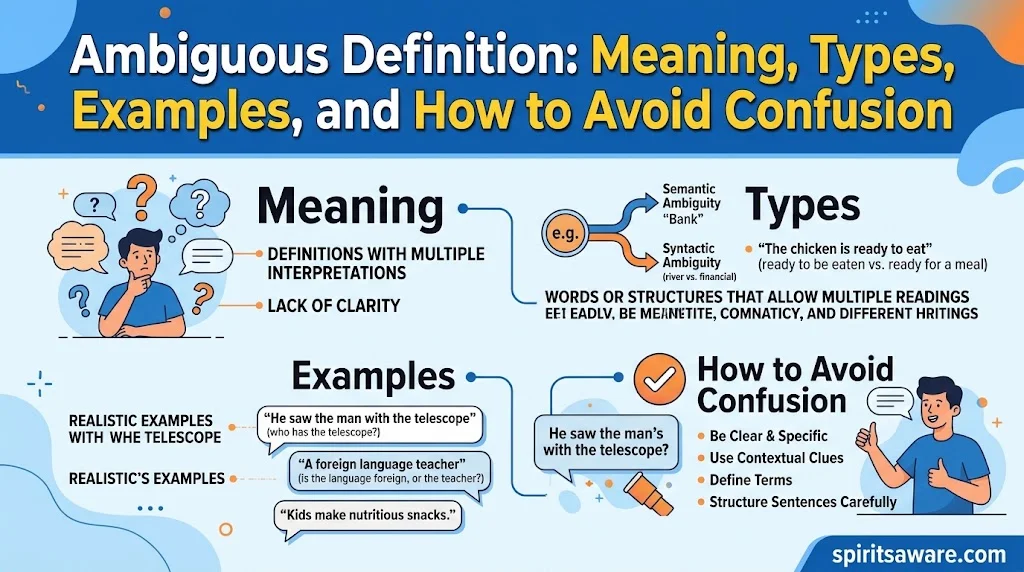
A sentence can be grammatically correct and still leave a reader wondering what it means. Consider the instruction, “Meet me by the bank.” Does the speaker mean a financial institution or the land beside a river? Without context, both interpretations are possible. This is a simple example of ambiguity: language that allows more than one reasonable meaning.
Understanding the ambiguous definition helps you read carefully, communicate clearly, and recognize why the same words can lead people to different conclusions. Ambiguity appears in everyday conversation, school assignments, business messages, contracts, literature, and public statements. Sometimes it creates humor or artistic depth. In other situations, it causes avoidable mistakes.
Quick Answer
An ambiguous definition is a definition, word, phrase, or statement that can reasonably be understood in more than one way. The related term ambiguity describes the presence of multiple possible meanings or interpretations. For example, “I saw her duck” could mean that you saw her lower her head or that you saw a duck belonging to her. The surrounding context often helps identify the intended meaning, but a writer can remove ambiguity by choosing more precise wording.
What Does “Ambiguous” Mean?
The adjective ambiguous describes something that has more than one possible meaning or does not make the intended meaning clear. Its noun form is ambiguity. A statement is ambiguous when readers or listeners can interpret it in different ways without either interpretation being obviously unreasonable.
For instance, “The teacher spoke to the student with a notebook” leaves a question unanswered. Did the teacher use a notebook, or was the student carrying one? The sentence does not clearly connect the phrase “with a notebook” to the person who had it.
Ambiguity is not always a sign of poor writing. In a mystery story, a poet may deliberately choose words that support two interpretations. In a work schedule or safety instruction, however, readers usually need one clear meaning.
Ambiguous Definition vs. Ambiguity
These expressions are closely related, but they are not identical in use. An ambiguous definition is a definition whose wording or boundaries permit multiple interpretations. Ambiguity is the broader condition of having more than one possible meaning.
For example, suppose a school rule says, “Students may use devices during approved activities.” If the rule does not explain which activities are approved or who approves them, students and teachers may interpret it differently. The wording is ambiguous because important terms are left open to interpretation.
A definition can also be incomplete without being ambiguous. “A mammal is an animal” is too broad to serve as a complete definition, but its problem is primarily lack of precision rather than two distinct meanings. This difference matters when you are trying to improve a definition: sometimes you must narrow its scope, while at other times you must separate competing interpretations.
Common Types of Ambiguity
Ambiguity can arise from a word, the arrangement of a sentence, or the situation in which something is said. The categories below are useful ways to recognize where confusion begins.
Lexical Ambiguity
Lexical ambiguity occurs when a word has more than one meaning. The word “bat,” for example, can refer to a flying mammal or a piece of equipment used in sports. The word “light” can refer to illumination or describe something that is not heavy.
Consider this sentence: “The box is light.” In ordinary conversation, it probably means that the box weighs very little. In a discussion about color or visual design, a reader might initially wonder whether “light” refers to its shade or brightness, especially if the box itself is being described in a broader visual context.
Lexical ambiguity is often resolved by the topic. If a baseball coach says, “Bring the bat,” the sporting meaning is likely. If a wildlife researcher says, “A bat entered the cave,” the animal is intended.
Syntactic or Structural Ambiguity
Syntactic ambiguity occurs when the grammatical structure of a phrase or sentence supports more than one interpretation. The words themselves may be familiar, but their relationships are unclear.
For example, “She saw the man with binoculars” has at least two readings:
- She used binoculars to see the man.
- She saw a man who had binoculars.
The phrase “with binoculars” can be connected to the act of seeing or to the man. Rewriting the sentence removes the uncertainty: “Using binoculars, she saw the man” makes the first meaning clear. “She saw the man who was carrying binoculars” makes the second meaning clear.
Structural ambiguity is especially common in long sentences containing several descriptive phrases. Readers may have to pause and reconstruct who did what, or which detail belongs to which person or object.
Contextual or Pragmatic Ambiguity
Pragmatic ambiguity arises when the intended meaning depends on context, tone, shared knowledge, or the speaker’s purpose. The words may have a fairly clear literal meaning, yet the listener may not know what the speaker intends to communicate.
Imagine a colleague looks at a draft and says, “That’s interesting.” The comment could express genuine curiosity, polite disagreement, surprise, or restrained criticism. The words alone do not settle the matter. Tone, the surrounding conversation, and the relationship between the speakers help determine the likely interpretation.
This kind of ambiguity is common in indirect requests and everyday social communication. “It’s cold in here” might simply report the temperature, or it might indirectly ask someone to close a window. The intended meaning depends on the situation.
Morphological Ambiguity
Morphological ambiguity occurs when a word form can be analyzed in more than one grammatical way. In English, the ending “-s” can mark a plural noun, as in “books,” or a present-tense verb form, as in “she walks.” Context and sentence structure usually make the role clear.
A form can also be difficult to interpret when a word boundary or grammatical attachment is unclear. These cases are more technical than everyday word ambiguity, but they matter in language study and in systems that analyze or process text.
Ambiguity vs. Vagueness, Uncertainty, and Incompleteness
Ambiguity is often confused with related problems. Distinguishing them makes definitions and explanations more accurate.
| Concept | What it means | Example |
| Ambiguity | Two or more distinct interpretations are possible. | “I saw her duck” may refer to an action or an animal. |
| Vagueness | A term has unclear boundaries or borderline cases. | “The room is large” does not specify exactly how large. |
| Uncertainty | Someone does not know which claim or outcome is true. | “I’m not sure whether the train has arrived.” |
| Incompleteness | Important information is missing. | “Submit the form by…” gives no deadline. |
| Generality | A statement covers a broad category rather than one specific case. | “Bring a book” does not name a particular title. |
These distinctions are helpful, although real examples can involve more than one problem at once. A vague rule may also be incomplete, and a sentence may be ambiguous because it omits information that would otherwise clarify its structure.
The practical question is: What exactly is causing the reader’s difficulty? If one word has two meanings, choose a more specific word. If a sentence can be parsed in two ways, change its structure. If a deadline or condition is missing, supply the missing information. If the boundaries of a term are unclear, define measurable criteria.
Everyday Examples of Ambiguous Statements
Ambiguity becomes easier to recognize when you see how it works in ordinary situations.
“I’ll meet you next Friday.”
Depending on the date and the speakers’ habits, “next Friday” may mean the coming Friday or Friday of the following week. The phrase is not always ambiguous in every context, but it can be interpreted differently. A clearer message gives the date: “I’ll meet you on Friday, October 30.”
“Please put the files by the desk.”
“By the desk” might mean beside the desk or, less commonly in a particular context, by way of the desk as a transfer point. If placement matters, say “Place the files on the desk” or “Place the files on the floor beside the desk.”
“Old friends and teachers attended.”
This sentence may suggest that the friends and teachers are old, or that only the friends are old while the teachers are being described as a separate group. If the distinction matters, rewrite it: “Longtime friends and teachers attended” or “Old friends and current teachers attended.”
“The manager discussed the issue with the employee.”
This can be read as a discussion between the manager and employee, but in a larger sentence, “with the employee” might also describe who was associated with the issue. Most readers will infer the usual meaning from context, yet a sensitive report may need more explicit wording.
The lesson from these examples is not that every sentence needs extra words. It is that important information should not depend on a reader guessing which interpretation you intended.
Why Ambiguity Matters
Ambiguity can be harmless, useful, or costly depending on the situation.
In everyday conversation, context often makes an unclear phrase easy to understand. If someone says, “Can you pass the salt?” listeners generally recognize a request rather than a question about physical ability.
In education, ambiguous instructions can cause students to complete the wrong task even when they understand the subject. Teachers can reduce this risk by specifying the required format, length, materials, and deadline.
In business communication, unclear wording can lead to inconsistent expectations. A message such as “Send the report soon” does not define a deadline. A more useful instruction says, “Email the final report by 3 p.m. Tuesday.”
In contracts, policies, and rules, wording may matter because people need to understand duties, permissions, exceptions, and consequences. Ambiguous language can produce disagreement about what a document requires. The effect of any particular wording depends on the document and applicable law; a general explanation cannot determine the legal meaning of a specific contract.
In literature and entertainment, ambiguity can be a deliberate technique. A poem may invite several interpretations, or a mystery may conceal a character’s true intentions. The uncertainty encourages readers to think rather than simply receive one fixed answer.
How to Identify an Ambiguous Definition
When a definition seems unclear, use a short review process.
- Read it without assuming the intended meaning. Ask what a reasonable reader could understand from the words as written.
- List the possible interpretations. If you can identify two distinct meanings, write each one in plain language.
- Locate the source of the problem. Is it a word with multiple meanings, an unclear grammatical connection, an undefined term, or missing context?
- Check whether context resolves it. A sentence may be clear within a paragraph but confusing when quoted on its own.
- Test it with a reader. Ask someone unfamiliar with your intention what the sentence means to them. Their interpretation can reveal assumptions you did not notice.
- Rewrite and test again. Use precise terms, a clearer sentence structure, or an explicit condition. Then check that the revised wording preserves the meaning you want.
This process is useful for essays, instructions, website copy, reports, policies, and definitions in schoolwork.
Read More: Augusta Precious Metals Lawsuit: What Investors Need to Know
How to Avoid Ambiguity in Writing
Clear writing does not require making every sentence long or formal. In most cases, small changes are enough.
Choose Specific Words
Replace general terms with concrete ones when the distinction matters. Instead of “Put it over there,” write “Put the blue folder on the top shelf.” Instead of “The meeting is soon,” give a date and time.
Make Pronoun References Clear
Pronouns such as “it,” “they,” “he,” and “she” can create confusion when several possible subjects appear in the same sentence.
Unclear: “When Maya spoke to Erin, she was upset.”
Clearer: “Maya was upset when she spoke to Erin,” or “Erin was upset when Maya spoke to her.”
Choose the version that accurately expresses the intended meaning.
Place Descriptive Phrases Beside the Words They Describe
Unclear: “The assistant handed the report to the director in a blue folder.”
Did the director have the blue folder, or was the report inside it? A clearer version might be: “The assistant handed the director the report, which was inside a blue folder.” If the folder belongs to the director, say so directly.
Define Important Terms
Words such as “reasonable,” “prompt,” “appropriate,” and “significant” may be useful in ordinary conversation, but they can be too open-ended when a precise rule is needed. Explain what the term means in the specific situation. For example, replace “Respond promptly” with “Respond within two business days” when that is the actual requirement.
State Conditions and Exceptions
Instructions become more reliable when they explain who must act, what action is required, when it must happen, and which exceptions apply. “Employees may work remotely when approved by their manager” is clearer than “Remote work is allowed sometimes,” though a formal policy may still need to explain the approval process.
Read the Sentence From the Reader’s Perspective
Writers know what they intended to say, so they can overlook gaps in their own wording. During editing, ask: “Could a reader reasonably interpret this another way?” Pay particular attention to dates, quantities, pronouns, comparisons, instructions, and phrases beginning with “with,” “near,” “after,” or “before.”
When Ambiguity Is Useful
Not all ambiguity needs to be eliminated. In creative writing, a double meaning can make a joke work, create suspense, or allow a story to support different interpretations. A character who says, “I never said she stole the money” can imply different things depending on which word receives emphasis.
Ambiguity can also be useful in brainstorming and early-stage problem-solving, when a question is intentionally open to multiple possibilities. It may encourage people to explore interpretations they would otherwise overlook.
The key is to match the level of clarity to the purpose. A poem, slogan, or mystery may benefit from several meanings. A medication instruction, emergency procedure, payment term, or assignment deadline usually needs direct and unambiguous wording. When misunderstanding could have serious consequences, clarity should take priority over cleverness.
FAQs
What is the simple definition of ambiguous?
Ambiguous means having more than one possible meaning or being unclear about which meaning is intended. For example, “I saw her duck” can describe seeing her lower her head or seeing a duck that belongs to her.
What is an ambiguous definition in English?
An ambiguous definition is a definition that can reasonably be interpreted in two or more ways. It may use a word with multiple meanings, rely on unclear sentence structure, or leave an important term open to different interpretations.
What is the difference between ambiguous and vague?
An ambiguous expression supports distinct interpretations. A vague expression has unclear boundaries. “Bank” can refer to a financial institution or a river’s edge, while “expensive” is vague unless the situation provides a standard for what counts as expensive.
Is ambiguity always a mistake?
No. Ambiguity can create humor, suspense, wordplay, or depth in literature. It becomes a problem when readers need one definite interpretation to act correctly, such as when following instructions or understanding a policy.
How can I make an ambiguous sentence clear?
Identify the possible meanings, decide which one you intend, and rewrite the sentence to make that meaning explicit. Use specific words, clarify pronouns, move descriptive phrases beside the words they describe, and include missing dates, conditions, or definitions when necessary.
Conclusion
An ambiguous definition allows more than one reasonable interpretation, which can make communication confusing when readers need a single clear meaning. Ambiguity may come from a word’s multiple meanings, sentence structure, grammatical form, or the context in which a statement is used. It differs from vagueness, uncertainty, and missing information, even though these problems can overlap.
To improve clarity, identify the competing interpretations and revise the exact part of the wording that causes them. Use direct language when accuracy matters, while allowing multiple meanings when they serve a creative purpose. The goal is not to remove every possible interpretation from language; it is to make sure the wording fits the reader’s needs and the situation.

Amelia Brooks is the visionary behind Spirits Aware, dedicated to guiding others on their journey of spiritual awakening and conscious living. Through insight, intuition, and experience, she shares empowering wisdom to help you reconnect with your inner truth.