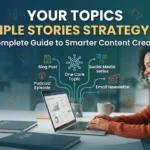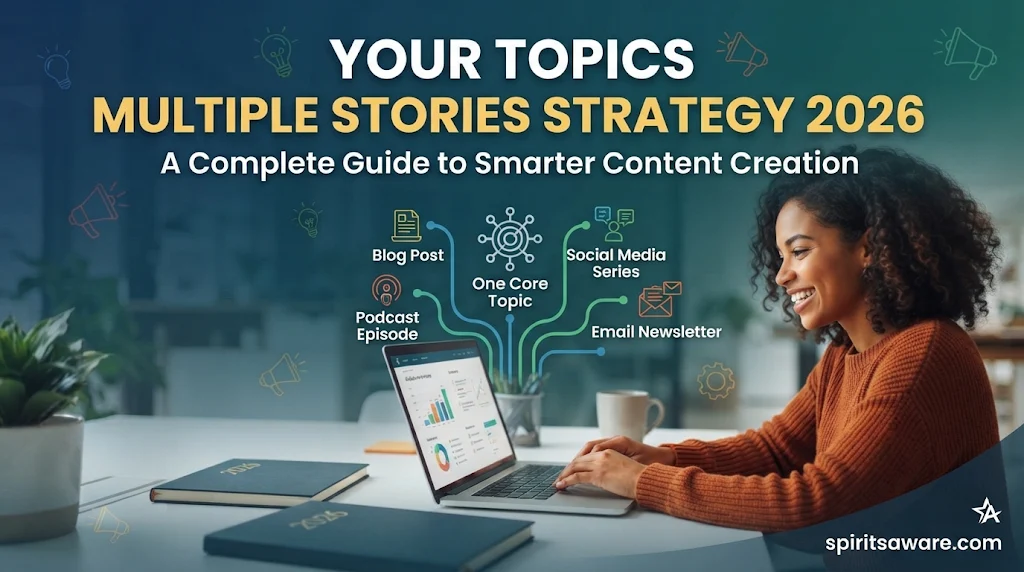
Your Topics Multiple Stories Strategy helps bloggers turn one core idea into several focused stories that attract readers, strengthen topical authority, and support growth.
Instead of publishing a single article about a broad subject, this strategy breaks the topic into multiple related stories, each answering a specific question or meeting a distinct search intent. For example, one main topic can inspire beginner guides, practical tutorials, expert tips, comparisons, and frequently asked questions. Every article should offer original value, target a relevant keyword, and connect naturally with the others through internal links. This organised approach creates a useful content cluster, helps readers explore a subject in depth, and gives search engines clearer context about your website’s expertise across related subjects.
To make the strategy effective, begin with keyword research and identify the questions your audience is searching for. Group related keywords by intent, then create a publishing plan that avoids repetitive or thin content. Give each story a clear purpose, descriptive heading, engaging introduction, and helpful information that satisfies the reader. Link supporting articles to a pillar page, and update older posts as your coverage grows. Focus on content quality, relevance, and a smooth reading experience rather than increasing volume. Over time, this approach can build topical depth, improve discoverability, and attract qualified organic traffic.
Quick Answer: What Is the Your Topics | Multiple Stories Strategy?
The Your Topics | Multiple Stories Strategy is a content planning approach in which one central topic becomes the foundation for several distinct, connected pieces of content. Each piece explores a different angle, answers a specific question, or serves a particular audience need while remaining connected to the main subject.
For example, a website covering personal finance could publish separate articles about budgeting for beginners, reducing household expenses, building an emergency fund, and avoiding common budgeting mistakes. These articles support one broader subject while addressing different reader concerns.
The goal is to create a connected collection of useful content rather than a series of unrelated posts. In 2026, this strategy is especially relevant to creators who want to organize their expertise, make better use of existing research, and build a sustainable publishing workflow without sacrificing originality.
What Does Your Topics | Multiple Stories Mean?
At its core, the strategy combines two ideas: topic-focused planning and multiple storytelling angles.
Topic-focused planning means choosing a central subject that matters to your audience. Multiple storytelling means exploring that subject in several meaningful ways instead of explaining everything through a single article or post.
Imagine that your main topic is home gardening. A single introductory article might explain how to start a garden, but it cannot answer every question a beginner or experienced gardener might have.
You could develop additional content about soil preparation, choosing plants for small spaces, watering schedules, common gardening mistakes, seasonal maintenance, and affordable tools.
Each article has its own purpose, yet the collection provides a more complete understanding of gardening.
The Difference Between a Topic and a Story
A topic is the broad subject you want to cover. A story is a specific way of presenting information about that subject.
Consider this example:
- Main topic: Remote work.
- Practical guide: How to set up a productive home office.
- Problem-solving article: How to manage distractions while working remotely.
- Personal perspective: Lessons learned from managing a remote team.
- Comparison: Remote work versus office-based work.
- Beginner’s guide: Essential tools for a first remote job.
- Mistakes article: Common remote-work habits that reduce productivity.
These examples are connected, but they do not serve exactly the same purpose.
A useful multiple-stories strategy ensures that each piece adds a new explanation, solves a different problem, or helps readers make a different decision.
Why the Strategy Matters in 2026
Content creators have to compete for attention across search engines, social platforms, newsletters, video channels, and other digital environments. Publishing more frequently alone does not guarantee better results.
A more thoughtful approach starts with understanding what your audience needs and then creating content that addresses those needs.
The strategy can help you:
- Generate relevant content ideas from subjects you already understand.
- Organize related articles into a logical structure.
- Address different audience questions without relying on one oversized article.
- Improve content consistency through advance planning.
- Repurpose research efficiently while creating genuinely new material.
- Help readers discover related information through useful internal links.
- Identify content gaps in your existing library.
However, these benefits depend on execution. Search visibility, engagement, and business results are not guaranteed simply because several articles cover the same topic.
How the Multiple Stories Strategy Works
The process begins with one central subject and gradually develops into a structured collection of related content.
Rather than brainstorming random ideas, you work through a series of planning decisions.
Choose One Strong Central Topic
Start by identifying a subject that aligns with your audience’s interests and your website’s purpose.
A good topic should be relevant, specific enough to guide content creation, and broad enough to support several distinct questions.
For example, an online fitness publication might select strength training for beginners.
That subject naturally leads to questions about exercise selection, proper form, training schedules, recovery, equipment, and progress tracking.
By contrast, a subject such as “everything about health” may be too broad to create a focused content plan without additional boundaries.
When evaluating a topic, ask yourself:
- Does my audience care about this subject?
- Can I provide accurate and useful information about it?
- Are there several genuinely different questions to answer?
- Does the subject fit my website’s overall focus?
- Can I support the content with reliable evidence or relevant expertise?
Choose a topic that offers meaningful opportunities for helping readers rather than one that simply appears popular.
Identify Different Audience Needs
Once you select a topic, think about the different reasons people might search for information about it.
Some readers need a basic explanation. Others want to solve a problem, compare options, improve an existing process, or make a purchasing decision.
For a topic such as email marketing, the audience might include:
- Beginners who need to understand how email marketing works.
- Small business owners who want to build an email list.
- Experienced marketers who want to improve campaign performance.
- Ecommerce businesses that need abandoned-cart emails.
- Freelancers who want to select suitable email marketing software.
Each group has different questions, even though all of them share an interest in email marketing.
This step helps you move beyond surface-level topic variations and develop content with a clear purpose.
Build a List of Distinct Story Angles
Next, brainstorm possible stories under your main topic.
A practical starting point is to explore different dimensions of the subject:
| Content angle | Purpose | Example |
| Beginner’s guide | Explain the basics | Email Marketing Explained for Beginners |
| Tutorial | Teach a process | How to Create Your First Email Campaign |
| Problem-solving | Address a challenge | How to Improve Email Deliverability |
| Comparison | Help readers evaluate options | Email Marketing vs. Social Media Marketing |
| Mistakes and lessons | Prevent common problems | Email Marketing Mistakes to Avoid |
| Case study | Examine a documented example | How a Business Improved Its Email Campaigns |
| Checklist | Make a process easier to follow | Email Campaign Launch Checklist |
| Advanced guide | Explore a specialized subject | Email Segmentation and Personalization |
These are planning options, not a mandatory checklist. Choose only the angles that make sense for your topic and audience.
Give Every Story a Clear Purpose
Before creating an article, write down the specific question it should answer.
For example, an article about email subject lines should not become another general guide to email marketing. Its purpose should be to explain how subject lines work, how to write them clearly, and how to evaluate their performance.
A simple content brief can include:
- Target reader: Who needs this information?
- Primary question: What problem should the article solve?
- Main takeaway: What should readers understand afterward?
- Supporting information: Which examples, facts, or instructions are necessary?
- Next step: What related resource might help the reader?
This process makes each story more focused and reduces unnecessary overlap across your content collection.
The Five-Angle Framework for Creating Multiple Stories
A useful way to expand one topic is to examine it through five different lenses: audience, purpose, perspective, format, and depth.
These lenses are a practical planning framework, not an official search-engine rule. You can combine them to generate ideas without creating repetitive content.
Audience: Who Needs This Information?
Different readers may need different explanations of the same subject.
For example, an article about website analytics could target a complete beginner, a small business owner, or an experienced marketing analyst.
A beginner might need help understanding page views, sessions, and conversions. A business owner might want to know which metrics indicate whether marketing efforts are working.
An analyst may need more advanced information about measurement methods and data quality.
The important distinction is that audience-specific content should change the explanation or practical value, not merely the vocabulary.
Purpose: What Does the Reader Want to Accomplish?
Content can serve several purposes:
- Learn: Understand a concept or process.
- Do: Complete a task.
- Compare: Evaluate alternatives.
- Solve: Fix a problem.
- Decide: Choose a product, service, or approach.
- Improve: Make an existing process more effective.
For example, someone searching for “what is website hosting” needs a different article from someone searching for “how to choose website hosting for an online store.”
Both topics concern hosting, but the reader’s immediate goals are different.
Perspective: Which Part of the Subject Needs Attention?
A topic may become clearer when viewed from several perspectives.
Consider sustainable packaging. One article could explain its environmental considerations, another could explore the practical challenges businesses face, and a third could compare packaging materials.
A separate article might examine consumer expectations or the importance of evaluating environmental claims.
These perspectives provide depth while allowing each article to focus on a specific question.
When using interviews or personal experiences, ensure that quotations and claims are genuine. Do not invent customer stories or present hypothetical examples as documented events.
Format: How Should the Information Be Presented?
Different formats are useful for different learning needs.
- How-to articles explain processes step by step.
- Comparison tables help readers evaluate alternatives.
- Checklists support repeatable tasks.
- Videos demonstrate visual or practical procedures.
- Infographics summarize relationships or processes.
- Frequently asked questions address common uncertainties.
- Case studies examine real situations supported by evidence.
You can use several formats to cover one subject, but changing the format alone does not automatically create a new story.
For example, turning an article into a video is repurposing. A video that demonstrates a process in greater detail may offer additional value beyond the original article.
Depth: How Far Should the Explanation Go?
Some subjects require only a concise explanation. Others deserve detailed guides, technical discussions, or advanced tutorials.
For example, a beginner’s article about search engine optimization might explain how search engines discover and understand web pages. A more advanced article could explore technical auditing, indexing issues, or website architecture.
Use depth to meet the reader’s needs rather than making every article longer.
The best content collection balances accessibility with expertise. It gives beginners a starting point while providing meaningful next steps for readers who want to learn more.
A Practical Example: Turning One Topic Into Multiple Stories
Suppose you operate a website about personal productivity and want to build content around time management.
Instead of writing several similar articles about productivity tips, you can organize the subject around distinct reader needs.
| Story idea | Reader’s main question | Unique value |
| Time Management for Beginners | Where should I start? | Introduces basic principles |
| How to Plan a Productive Week | How do I organize my schedule? | Provides a practical routine |
| Time Blocking Explained | How can I assign time to tasks? | Explains one specific method |
| How to Manage Interruptions | How do I protect focused work? | Addresses distractions |
| Time Blocking vs. To-Do Lists | Which approach fits my needs? | Compares two planning methods |
| Time Management Mistakes | What might be making me less productive? | Identifies common problems |
| Time Management for Remote Teams | How can teams coordinate their work? | Addresses a workplace-specific need |
The result is a connected collection in which each article answers a distinct question.
Organize the Articles Around a Main Guide
Create one comprehensive article that introduces time management and directs readers to more detailed resources.
This main article acts as a content hub.
The supporting articles explore individual methods, problems, and audience needs in greater detail.
For example, the main guide might introduce time blocking in a few paragraphs and link to a dedicated tutorial for readers who want to learn the method step by step.
The tutorial can then link back to the main guide when readers need broader context.
This structure helps visitors navigate the subject without forcing every detail into one long page.
Avoid Creating Artificial Variations
Not every potential title deserves its own article.
Consider these three ideas:
- Best Time Management Tips
- Top Time Management Tips
- Effective Time Management Tips
Unless the articles serve meaningfully different purposes, they are likely to overlap substantially.
A better approach would be to publish one useful guide and explore distinct subtopics such as time blocking, prioritization, meeting management, or scheduling for shift workers.
Create more content by discovering more useful questions, not by producing more versions of the same answer.
Read More: Connections Hint Today Mashable: Hints and Answers for October 25, 2026
How to Build a Content Cluster Without Repeating Yourself
A content cluster is a group of related pages organized around a central subject. The multiple-stories strategy can help you plan such a cluster, but the two concepts are not identical.
The multiple-stories strategy focuses on developing different perspectives and narratives. A content cluster focuses on organizing related pages and connecting them through site structure and internal links.
They work well together when every page serves a clear purpose.
Start With a Main Guide
Choose a central article that introduces the topic and covers the most important foundational information.
The guide should be useful on its own. It should not be an empty page that exists only to link to other articles.
For a website about home improvement, a main guide could cover planning a kitchen renovation, while supporting articles explain budgeting, material selection, project timelines, and contractor questions.
Create Supporting Articles With Clear Boundaries
Each supporting article should focus on one meaningful subtopic.
Before writing, compare its planned coverage with the existing content library.
Ask whether the proposed article:
- Answers a question that is not already addressed adequately.
- Provides a more focused explanation than the main guide.
- Includes useful examples or instructions.
- Has a clear audience and purpose.
- Can contribute to the wider topic without repeating entire sections.
If the idea adds little new value, improve the existing page instead of automatically creating another one.
Connect Related Articles With Internal Links
Internal links connect one page on your website to another page on the same website.
They help readers discover related resources and can help search engines understand relationships among pages.
Use links where they naturally support the reader’s next step.
For example, a guide to choosing running shoes could link to a separate article about understanding shoe fit or selecting footwear for different running surfaces.
Avoid adding irrelevant links simply to increase the number of internal links. Descriptive anchor text should communicate what readers can expect from the destination page.
How the Strategy Supports in 2026
The multiple-stories approach can support a well-organized search strategy, but it should not be treated as a guaranteed ranking technique.
Search engines aim to present useful results that satisfy people’s needs. A collection of related articles may help a website cover a subject thoroughly, but publishing more pages does not automatically establish expertise or improve rankings.
The value comes from the usefulness, accuracy, originality, and organization of the content.
Cover Different Search Intents
Search intent refers to the purpose behind a search.
Someone looking for “what is cloud storage” may want a basic explanation. Someone searching for “best cloud storage for small businesses” likely wants to compare options. Another person searching for “how to recover deleted cloud files” needs troubleshooting guidance.
A content strategy should recognize these differences.
Develop separate articles when the questions require substantially different answers. Combine closely related questions when a single page can answer them clearly.
Build Depth Without Keyword Stuffing
A well-planned topic collection can naturally include related concepts and terminology.
For example, a series about indoor gardening might cover grow lights, potting soil, drainage, watering, and plant selection.
These concepts belong because they help readers understand the subject. They should not be added simply to insert more search terms.
Use the language your audience naturally uses, define important technical terms, and keep each article focused on its central purpose.
Prioritize Original and Useful Information
Search visibility is not a substitute for reader value.
When creating multiple stories, improve the content with meaningful details such as:
- Original analysis or documented research.
- Clear explanations of difficult concepts.
- Practical instructions and realistic examples.
- Relevant expert input when available.
- Accurate comparisons based on appropriate criteria.
- Updated information when facts or recommendations change.
If you use AI tools during research or drafting, verify the output, check factual claims, and add genuine editorial judgment. Publishing unreviewed variations of generic content can undermine the quality of the entire collection.
Understand the Limits of the Strategy
Several articles about a subject do not guarantee that search engines will treat the website as authoritative.
A content cluster may also create problems if its pages compete for the same search intent or repeat information without adding value.
Use performance data to understand which pages help readers, which questions remain unanswered, and which articles need improvement.
Treat the strategy as a framework for better content planning rather than a shortcut to rankings.
How to Repurpose Content Without Making It Repetitive
Content repurposing means adapting existing material for a different format, channel, or audience.
It can complement a multiple-stories strategy, but it serves a different purpose.
For example, a detailed guide to home organization could become a short video demonstrating a decluttering technique, a checklist for organizing a closet, or an email summarizing a weekly routine.
Each adaptation should fit the destination format.
Repurpose the Insight, Not Just the Words
Start by identifying the most useful idea in your original content.
Then ask how that idea can help someone in a different context.
A long article might explain several project management methods. A short video could demonstrate one method in action, while a checklist could help readers implement it.
This is more useful than copying paragraphs into multiple formats without adapting them.
Choose Formats Based on Audience Behavior
Different channels support different types of interaction.
| Format | Best suited for | Example |
| Blog article | Detailed explanations and searchable information | A complete project planning guide |
| Short video | Demonstrations and concise lessons | A two-minute planning tutorial |
| Email newsletter | Ongoing education and updates | A weekly project management tip |
| Checklist | Repeatable actions | A project kickoff checklist |
| Social media post | Brief insights and discussion | A common planning mistake |
| Webinar | Detailed instruction and questions | A live project planning workshop |
You do not need to use every format. Select the channels your audience uses and the formats your team can maintain consistently.
How to Measure Whether the Strategy Is Working
A content strategy should be evaluated through evidence rather than assumptions.
Before publishing a collection of articles, decide what success means for your website. Different goals require different measurements.
Measure Relevant Performance Indicators
For an informational website, useful indicators may include organic search clicks, impressions, engaged visits, and the number of readers who continue to related pages.
For a business website, you may also track qualified leads, newsletter subscriptions, product inquiries, or sales that can reasonably be attributed to content.
Consider the following measures:
- Search impressions: How often your pages appear in search results.
- Organic clicks: How many clicks come from unpaid search results.
- Engagement: Whether readers interact meaningfully with your content.
- Internal navigation: Whether visitors discover related resources.
- Conversions: Whether readers complete a relevant action.
- Content maintenance: How much effort is required to keep the collection accurate and useful.
No single metric tells the whole story. High traffic may be less valuable than a smaller number of visits from people who genuinely need your service.
Review Performance Before Expanding the Cluster
After publishing, review the available data over an appropriate period.
Identify which pages attract the intended audience, which articles answer their questions effectively, and which pages appear to overlap.
You may discover that one supporting article deserves more detail, another should be merged with an existing guide, or an important reader question remains unanswered.
Use those findings to improve the collection.
A strong content strategy is a continuing process of research, publishing, evaluation, and refinement—not a one-time exercise in producing as many articles as possible.
Common Mistakes to Avoid
Even a well-planned multiple-stories strategy can fail when the focus shifts from helping readers to increasing publication volume.
Publishing Too Many Similar Articles
Small differences in wording do not necessarily create different content opportunities.
If several articles answer essentially the same question, readers may struggle to find the most useful page.
Review existing content before developing a new article, and combine overlapping material when doing so creates a clearer resource.
Choosing Topics Without Understanding the Audience
A topic may appear interesting to the content team but have little practical relevance to its intended readers.
Use customer questions, audience feedback, search data, and relevant industry discussions to identify real information needs.
Do not assume that every subject can support a valuable series simply because it is broad.
Focusing on Volume Instead of Quality
Publishing regularly can support a consistent workflow, but arbitrary publishing targets can encourage shallow content.
Give each article enough research, editing, and fact-checking to fulfill its purpose.
It is better to publish a smaller collection of distinct, useful resources than a large collection of pages with little meaningful difference.
Neglecting Existing Content
A website’s content library needs maintenance.
Information may become outdated, links may stop working, and newer articles may overlap with older ones.
Periodically review the collection, update important facts, improve unclear explanations, and remove or consolidate content when appropriate.
Treating Every Article as a Sales Pitch
Readers often need information before they are ready to make a purchase.
A useful content collection should respect that journey. Educational articles should explain their subjects honestly, comparisons should use relevant criteria, and promotional material should be clearly distinguished from neutral information.
Helping readers make informed decisions can be more valuable than inserting a sales message into every piece of content.
A Simple 30-Day Plan for Implementing the Strategy
You can start using the multiple-stories approach without rebuilding your entire website. A focused, four-week plan provides a practical starting point.
Week One: Research and Topic Selection
Choose one central subject that fits your audience and business goals.
Review existing content, collect common questions, and identify areas where your current resources are incomplete or repetitive.
By the end of the week, you should have a defined topic, an initial audience profile, and a list of potential content opportunities.
Week Two: Plan the Content Collection
Group the strongest ideas by reader need.
Select one main guide and several supporting articles that serve different purposes. Write a short brief for each proposed page, including its audience, main question, intended value, and relationship to other resources.
Remove ideas that overlap too heavily with existing content.
Week Three: Create and Review Content
Research the selected subjects and begin drafting.
Prioritize accuracy, clarity, practical examples, and distinct article purposes. Add internal links where they genuinely help readers move between related resources.
Review each article for repetition, unsupported claims, grammatical errors, and unnecessary sections before publishing.
Week Four: Publish and Evaluate
Publish the material according to a realistic schedule.
Check that links work, headings are clear, and each article fulfills its stated purpose. Establish a baseline for relevant performance indicators and decide when to review the results.
Thirty days is enough to establish a workflow and begin evaluating content quality. It is not a universal timeframe for judging success, since search visibility and business outcomes can take longer to develop.
FAQs
What Is the Your Topics | Multiple Stories Strategy?
It is a content planning approach that develops several distinct pieces of content around one central topic. Each piece addresses a different question, audience need, perspective, or practical problem while contributing to a broader collection of related information.
Is the Multiple Stories Strategy Good ?
It can support an effective strategy when the content satisfies distinct search intents, offers useful information, and is organized clearly. However, the approach does not guarantee higher rankings, more traffic, or greater authority. Quality and relevance matter more than the number of articles published.
How Many Articles Should You Create for One Topic?
There is no universal number. Start with the questions your audience genuinely needs answered. A focused topic might support only a few useful articles, while a broader subject may justify a much larger collection. Stop expanding when new ideas no longer provide meaningful, distinct value.
What Is the Difference Between Multiple Stories and Content Repurposing?
Multiple stories explore a central subject through different questions, perspectives, or reader needs. Content repurposing adapts existing material for another format, platform, or audience. The approaches can work together, but changing an article’s format does not automatically create a new story.
Can Small Businesses Use This Strategy?
Yes. Small businesses can use it to answer customer questions, explain services, compare solutions, address common problems, and demonstrate relevant expertise. They can begin with a main guide and a small number of supporting articles, expanding the collection as genuine customer needs emerge.
Does Publishing More Content Automatically Improve Website Traffic?
No. More pages do not automatically produce more visitors. Content needs to be relevant, accurate, useful, and discoverable. Publishing several similar articles can waste resources and create unnecessary overlap. Focus on answering real questions and improving the quality of the overall content collection.
Can You Use AI to Create Multiple Stories From One Topic?
Yes. AI tools can help brainstorm angles, organize outlines, identify potential content gaps, and adapt material for different formats. However, each article still needs editorial oversight, factual verification, originality, and a clear purpose. Avoid publishing lightly modified drafts that repeat the same information without providing additional value.
Conclusion
The Your Topics | Multiple Stories Strategy 2026 provides a practical way to turn one meaningful subject into a connected collection of useful content. By exploring different audience needs, questions, perspectives, and formats, creators can build a more organized publishing process and help readers understand a topic more completely.
The most important principle is purpose over volume. Every article should answer a worthwhile question, provide a distinct benefit, or help readers take a meaningful next step. When your content works together without repeating itself, you create a stronger resource for your audience and a more sustainable foundation for long-term content development.

Hannah Collins is the voice behind Spirits Aware, sharing thoughtful perspectives on spiritual growth, awareness, and conscious living.