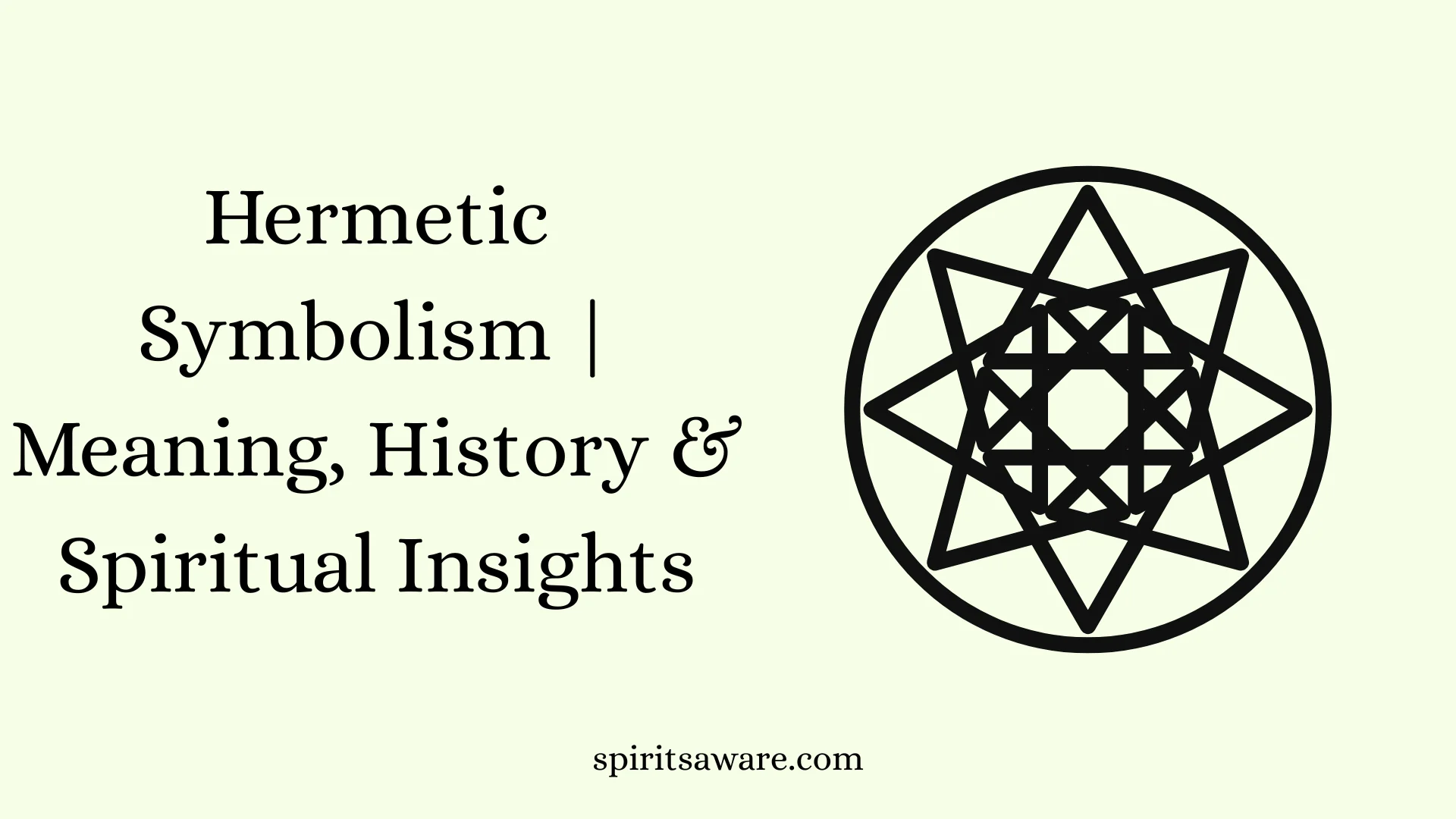
Hermetic symbolism refers to a collection of visual and conceptual emblems that express deep spiritual truths connected with the Hermetic tradition. At its heart is a set of philosophical principles about the nature of reality, consciousness, and transformation, expressed in symbols that carry layered meanings across cultures and ages. In the United States today, Hermetic symbols show up in everything from art and jewelry to personal spiritual practice — often divorced from their ancient origins yet still inviting curiosity about transformation and inner wisdom.
Quick Answer
Hermetic symbolism is the use of ancient esoteric symbols — like the Caduceus, Ouroboros, and All‑Seeing Eye — to express ideas about unity, transformation, and the interconnectedness of mind, matter, and spirit. It has roots in Greek‑Egyptian thought and influences modern mysticism and personal growth.
TL;DR
• Hermetic symbolism is a language of mystical and alchemical symbols.
• It reflects Hermetic teachings about unity and cosmic correspondence.
• Originates from Greco‑Egyptian Hermeticism and Renaissance revival.
• Symbols like Caduceus and Ouroboros express duality and cycles.
• In the USA, these symbols appear in art, jewelry, and spiritual subcultures.
• They are linked to psychological growth and personal transformation.
• Misuse often happens in pop culture and misunderstood medical symbols.
Overview: What Is Hermetic Symbolism and Why It Matters
Hermetic symbolism refers to a network of symbols used historically within Hermeticism — a philosophical and mystical tradition attributed to a legendary figure named Hermes Trismegistus, meaning “Thrice‑Great Hermes.” These symbols express concepts such as transformation, unity of opposites, spiritual ascent, and the connection between the visible world and unseen realities. Understanding Hermetic symbols can feel like learning a hidden language — one that has influenced Western esotericism, alchemy, psychology, and modern spirituality.
Hermetic symbols aren’t just decorative. They are meant to act as keys to insight, inviting viewers to reflect on their own inner lives and the universe’s deeper structure. Whether seen in ancient alchemical drawings or modern pendants, these emblems carry layers of meaning that evolved across time and cultures.
Origins of Hermeticism and Its Symbols
To understand Hermetic symbolism, we need to look at its historical roots.
Ancient Beginnings
Hermeticism emerged in late antiquity (1st–4th century CE) in the culturally mixed region of Hellenistic Egypt — especially Alexandria — where Greek, Egyptian, and Near Eastern ideas blended. The tradition’s core texts, like the Corpus Hermeticum and related writings, present teachings attributed to Hermes Trismegistus, a mythic blend of the Greek god Hermes and the Egyptian god Thoth. These texts explore cosmology, mind, spirit, and the path to divine knowledge (gnosis).
Hermetic thought also absorbed older spiritual imagery — including Egyptian symbols like the Ankh (eternal life) and serpentine motifs — giving them new metaphysical interpretations.
Renaissance Revival
During the Renaissance (14th–17th centuries), Hermetic texts were rediscovered and translated into Latin. Thinkers like Marsilio Ficino and Giordano Bruno wove Hermetic ideas into art, philosophy, and occult traditions, turning age‑old images into rich symbolic systems that influenced Western esotericism.
Alchemy: The Symbolic Laboratory
Alchemy became one of the main homes for Hermetic symbols. While medieval alchemists often pursued literal transformation of metals, Hermetic thought saw alchemical imagery as metaphors for spiritual transformation — turning “base” human nature into “gold” of wisdom and purity. Symbols within alchemy — suns, dragons, and cryptic glyphs — emerged as codes for psychological and spiritual processes.
Core Hermetic Symbols: Forms and Meanings
Hermetic symbolism isn’t limited to one image. It includes a wide visual vocabulary. Below is a closer look at some widely discussed Hermetic emblems:
1. The Caduceus
- Appearance: A staff with two serpents winding around it and often wings at the top.
- Hermetic meaning: Represents duality and balance — intersecting opposites (light/dark, spirit/matter) — and the harmonizing of forces.
- Modern note: In the United States, the Caduceus is often used as a medical symbol, though this is historically mistaken. The true medical emblem is the Rod of Asclepius (one serpent, no wings).
2. The Ouroboros
- Appearance: A serpent eating its own tail, forming a circle.
- Meaning: Cycle of birth, death, and rebirth; eternity and self‑reflection. In Hermeticism it suggests that beginnings and endings are one, and that transformation is continuous.
3. The All‑Seeing Eye
- Appearance: An eye inside a triangle, often radiating light.
- Meaning: Insight into hidden truths, divine awareness, and inner wisdom. Sometimes linked to the idea that reality is known through insight rather than surface appearances.
4. The Philosopher’s Stone
- Meaning: Not a literal rock, but a symbol of spiritual perfection and transformation. It embodies the journey from ignorance to enlightenment — the ultimate Hermetic goal.
5. Geometric Forms
- Triangles: Represent elements (fire, water) or the joining of realms (spirit/material).
- Circles: Suggest unity, wholeness, and the eternal nature of the cosmos.
- Squares: Stand for material reality and structure.
Each shape encodes layers of cosmic and psychological meaning.
Hermetic Symbolism in the USA: From Esoterica to Pop Culture
Hermetic symbols have made their way into American culture in subtle and surprising ways.
Spiritual and New Age Communities
In the United States, Hermetic symbols — especially the Ouroboros and geometric figures — appear in yoga studios, meditation circles, and spiritually oriented spaces. Many people use them as reminders of transformation and inner balance.
Art and Music
Modern American artists sometimes draw on Hermetic imagery to convey themes of mystery or inner journey. In music and album art, such symbols often hint at deeper philosophical themes.
Personal Expression and Identity
Hermetic symbols appear as:
• Jewelry (pendants, rings)
• Tattoos (Ouroboros, eye motifs)
• Decor (prints of mystical emblems)
These uses usually focus on empowerment, self‑discovery, or appreciation for mystery.
Popular Media
While not mainstream, Hermetic imagery shows up in films, games, and literature with mystical or fantasy elements. These often simplify the symbols into general “magic” tropes, which can blur but also spread awareness of deeper symbolic roots.
Emotional & Psychological Associations
Hermetic symbols often connect with inner experiences and psychological themes. In modern interpretations, they are not just “mystical decorations” but mirrors for personal change.
Transformation
Symbols like the Ouroboros or Philosopher’s Stone resonate with people going through personal growth — representing cycles of challenge and renewal.
Balance
The dual serpents of the Caduceus suggest harmonizing conflicting inner forces — rational and emotional, masculine and feminine.
Insight and Awareness
The All‑Seeing Eye can symbolize self‑observation and introspection — looking beyond surface habits toward inner truths.
In psychology, especially in the work of thinkers like Carl Jung, Hermetic and alchemical imagry has been used metaphorically to describe the process of individuation — integrating unconscious parts of oneself to become whole.
Cross‑Cultural and Spiritual Meanings
Although born from a Greek‑Egyptian blend, many Hermetic symbols overlap with other traditions:
• Ankh: Originally Egyptian symbol of life and eternity — later woven into Hermetic thought.
• Serpent motifs: Found worldwide (e.g., ouroboros in Norse myth, snake imagery in Indigenous cultures). In Hermeticism, they specifically represent cycles and duality.
• Geometric shapes: Triangles, circles, and squares appear in sacred geometry across Asia, the Middle East, and Europe.
When people use Hermetic symbols today, they may not always know these cross‑cultural roots — but the shared visual language points to universal themes: life, transformation, and interconnectedness.
Modern Usage: How Americans Encounter Hermetic Symbols
Hermetic symbols have found an enthusiastic audience online and offline.
Tattoos
People often choose symbols like the Ouroboros or Eye of Providence as body art, typically to express personal transformation, protection, or deep awareness.
Jewelry and Fashion
Many symbols appear on necklaces, bracelets, and rings. Some are worn for aesthetic appeal, others as personal spiritual reminders.
Home Decor and Art
Prints, posters, and sculptures with Hermetic imagery populate spaces dedicated to reflection or meditation.
Digital Culture
Hashtags on social platforms bring together those interested in mystical symbols for discussion and sharing. Hermetic emblems often travel alongside other esoteric and New Age ideas.
Misunderstandings, Misuse & Controversies
Hermetic symbols sometimes get misunderstood or appropriated without context.
The Caduceus in Medicine
In the U.S., the Caduceus is used as a medical emblem — especially by the Army Medical Corps — but this is a historical mix‑up. The Rod of Asclepius (single serpent) is the traditional symbol of healing.
Overgeneralization in Pop Culture
Films and games sometimes use Hermetic imagery loosely as “mystic codes” without conveying deeper teachings. This can flatten rich symbolic meaning into generic “magic tropes,” losing nuance.
New Age Blends
Some modern spiritual groups blend Hermetic symbols with unrelated beliefs, creating hybrid interpretations. While creative, this can obscure historical meanings if not acknowledged.
In all cases, respectful engagement with the history and symbolism helps separate surface aesthetics from deeper meaning.
How Hermetic Symbolism Has Shifted Over Time
Hermetic symbolism has evolved from secretive spiritual language to widely recognized emblems in pop culture and personal spirituality:
• Ancient to Renaissance: Symbols were embedded in philosophical texts and alchemical manuscripts.
• 17th–19th century: Hermetic ideas influenced occult movements and early psychology.
• 20th–21st century: Symbols diffuse into general spiritual practice, art, and personal expression.
• Today: Hermetic images are accessible through books, online communities, and media, often reinterpreted but still echoing ancient themes of unity and transformation.
Read More: Evil Symbolism: Spiritual, Cultural & Literary Meaning
Hermetic Symbols at a Glance
| Symbol | Core Hermetic Meaning | Common Associations | Modern Use |
| Caduceus | Balance of opposites | Duality, harmony | Jewelry, misunderstood medical emblem |
| Ouroboros | Eternal cycle | Renewal, continuity | Tattoos, art |
| All‑Seeing Eye | Inner awareness | Wisdom, insight | Decor, spiritual imagery |
| Philosopher’s Stone | Spiritual transformation | Enlightenment, integration | Symbol in literature, esoteric practice |
| Geometric Forms | Cosmic order | Unity, elements | Sacred geometry in art |
FAQs
What is Hermetic symbolism?
Hermetic symbolism is the use of esoteric symbols in Hermeticism to express spiritual truths about unity, transformation, and cosmic connection. It ties visual emblems to ideas about inner growth and metaphysical principles.
Where did Hermetic symbols originate?
They originated in the Hermetic tradition — a blend of Greek and Egyptian thought in late antiquity — and were revived in the European Renaissance as part of philosophy, alchemy, and mystical study.
Is Hermetic symbolism religious?
Not in the way mainstream world religions are. While it has spiritual and mystical content, Hermeticism is more a philosophical‑esoteric path that complements personal spirituality rather than a formal religion.
Why is the Caduceus used in medicine in the USA?
The Caduceus became a medical emblem in the U.S. due to historical misunderstanding. The traditional healing symbol is the Rod of Asclepius. Hermetic associations focus on balance and transformation, not healing professions per se.
Can Hermetic symbols be used in personal spiritual practice?
Yes. Many people use them for reflection, meditation, or as reminders of personal growth, balance, and insight. Just be mindful of their rich history and layered meanings.
Conclusion
Hermetic symbolism remains a fascinating bridge between ancient esoteric thought and modern spiritual curiosity. From the entwined serpents of the Caduceus to the infinite circle of the Ouroboros, each emblem invites us to explore not only cosmic mysteries but our own inner landscapes. Whether appreciated as art, worn as personal expression, or studied for deeper insight, Hermetic symbolism continues to spark reflection on transformation, unity, and the hidden connections that weave through life — connecting ancient traditions to contemporary seekers in the USA and beyond.

Amelia Brooks is the visionary behind Spirits Aware, dedicated to guiding others on their journey of spiritual awakening and conscious living. Through insight, intuition, and experience, she shares empowering wisdom to help you reconnect with your inner truth.