The forget-me-not may be small, but its message is anything but quiet. In gardens, on tattoos, and at memorial events, this delicate blue bloom carries a powerful story about love and remembrance. In the United States, it often appears during moments of loss, tribute, or deep personal reflection.
Forget-Me-Not Flower Symbolism: Love, Memory, and Spiritual Meaning has roots in medieval legend and centuries of tradition. Yet today, it feels just as meaningful as ever. Because the flower’s name itself sounds like a plea, many people see it as a living symbol of connection that lasts beyond distance, time, and even death.
So what exactly does this tiny blue flower represent? And how did it become a modern emblem of memory and loyalty in American culture?
Quick Answer
In the United States, Forget-Me-Not Flower Symbolism: Love, Memory, and Spiritual Meaning centers on remembrance, enduring love, and loyalty. It often represents honoring loved ones who have passed, staying emotionally connected across distance, and spiritual continuity. Across cultures, it also reflects faithfulness, humility, and lasting bonds.
TL;DR
• Symbol of remembrance and lasting love
• Linked to medieval European legend
• Used in U.S. memorials and awareness causes
• Represents loyalty and faithfulness
• Popular in tattoos and tribute jewelry
• Suggests spiritual connection beyond death
What Is the Forget-Me-Not Flower?
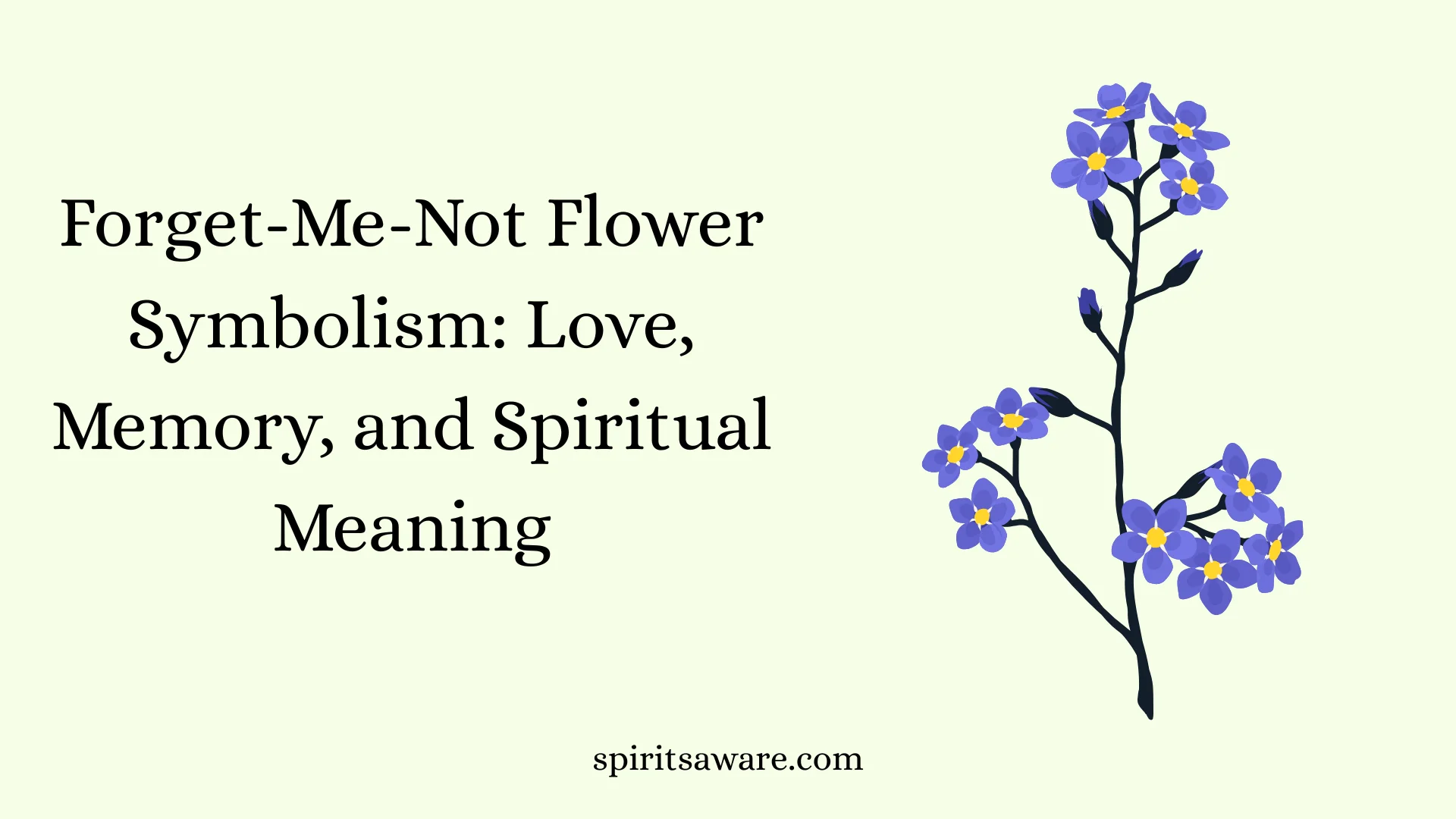
Before exploring meaning, it helps to understand the flower itself. The forget-me-not belongs to the genus Myosotis, a group of small flowering plants known for their bright blue petals and yellow centers.
Although tiny, the bloom stands out because of its color and simple shape. It usually grows in clusters, forming soft carpets of blue in gardens and wild areas.
Physical Description and Appearance
The forget-me-not is easy to recognize:
• Five rounded blue petals
• Small yellow or white center
• Grows low to the ground
• Blooms in spring and early summer
• Often found near water or woodland edges
Because it’s delicate yet resilient, many people see the flower as humble but strong.
Where Did the Forget-Me-Not Get Its Name?
The name “forget-me-not” sounds like a whisper from the past. Its origin comes from European folklore, especially German legend.
The Medieval Legend
One well-known story comes from medieval Germany. A knight and his lady were walking by a river. He picked the small blue flowers for her but fell into the water due to his heavy armor. As he was swept away, he tossed the bouquet to her and cried, “Vergiss mein nicht,” meaning “forget me not.”
Over time, the phrase became the flower’s common name in many languages.
• German: “Vergissmeinnicht”
• French: “Ne m’oubliez pas”
• English: “Forget-me-not”
• Dutch: “Vergeet-mij-nietje”
Because of this legend, the flower became linked to tragic love and eternal remembrance.
Historical Roots and Early Symbolism
Although the popular legend is medieval, the flower’s symbolism developed over centuries in Europe.
Christian and Pre-Christian Meanings
In Christian art, the forget-me-not sometimes appeared in paintings to represent God’s watchful memory of humanity. The flower’s sky-blue color was also associated with the Virgin Mary in medieval symbolism.
Before that, blue flowers often symbolized devotion and longing in European folklore. Because blue was rare in nature, it carried a sense of mystery and depth.
Renaissance and Victorian Eras
By the Renaissance, the forget-me-not symbolized loyal love. Later, in Victorian England, flowers became a coded language. This practice, called floriography, gave specific meanings to blooms.
In Victorian flower dictionaries, forget-me-nots meant:
• True love that endures
• Faithful devotion
• Remembrance after separation
• Memory of absent friends
These meanings traveled to America through European immigrants.
What Does the Forget-Me-Not Symbolize in the USA?
In the United States, the flower’s meaning has deepened over time. While love remains central, remembrance has become the strongest theme.
Memorial and Remembrance Symbol
The forget-me-not is often used in funerals and memorial gardens. It represents honoring those who have passed while keeping their memory alive.
Because its name feels direct and emotional, it resonates strongly in grief settings.
• Tribute to deceased loved ones
• Symbol of remembrance ceremonies
• Used in sympathy bouquets
• Planted in memory gardens
Today, many Americans see it as a gentle promise: “You are not forgotten.”
The Forget-Me-Not and Alzheimer’s Awareness
In modern America, the forget-me-not also connects to memory loss awareness. Because its name directly relates to memory, it has become a symbol in dementia and Alzheimer’s advocacy.
Although different organizations use various symbols, the forget-me-not is often associated with honoring those facing memory decline.
• Represents memory and identity
• Honors caregivers and families
• Used in awareness events
• Symbolizes dignity amid cognitive loss
This connection gives the flower a bittersweet layer of meaning in 2025–2026.
Spiritual Meaning of the Forget-Me-Not
Beyond romance and grief, the forget-me-not carries spiritual symbolism. Many people see it as a sign of soul connection.
Spiritual Themes
The flower is often interpreted as:
• Eternal soul bonds
• Connection beyond physical death
• Divine remembrance
• Spiritual loyalty
Because it blooms year after year, it also suggests renewal and continuity.
For some, seeing forget-me-nots after losing someone feels like a gentle spiritual reminder.
Emotional and Psychological Associations
Symbols matter because they shape feelings. The forget-me-not triggers strong emotional responses.
Common Feelings It Evokes
• Tenderness
• Nostalgia
• Hope during grief
• Loyalty and commitment
• Gentle comfort
Unlike dramatic red roses, the forget-me-not feels quiet and sincere. Therefore, it often appeals to people who value subtle, lasting affection.
Forget-Me-Not in Tattoos and Personal Art
Tattoos are one of the most common modern uses of this flower in the United States.
Why People Choose It
Forget-me-not tattoos often honor:
• A lost parent or grandparent
• A childhood memory
• A military friend
• A personal promise
Its small size makes it ideal for minimalist designs. Many pair it with names, dates, or birds.
Because the message is clear yet soft, it feels personal rather than flashy.
Forget-Me-Not in Decor, Jewelry, and Fashion
Beyond tattoos, the flower appears widely in everyday design.
Popular Modern Uses
• Memorial jewelry with pressed flowers
• Spring-themed home décor
• Wedding bouquets symbolizing loyalty
• Sympathy gift arrangements
• Vintage-inspired fabric prints
In weddings, especially, it suggests enduring partnership rather than intense passion.
Cross-Cultural Symbolism Around the World
Although strongly associated with Europe and America, the forget-me-not has meaning elsewhere too.
In some cultures, it represents protection and luck. In others, it’s simply admired for beauty. However, its primary global message remains memory and devotion.
Because it spread through migration and trade, its romantic meaning stayed consistent across regions.
Misunderstandings and Controversies
Most symbolism around the forget-me-not is positive. However, like many symbols, it has been used in different contexts over time.
In 20th-century Europe, the flower was briefly used by certain political groups. Today, that historical use is not its primary meaning in the United States.
In modern American culture, it overwhelmingly represents remembrance and love, not political ideology.
Therefore, context matters. A forget-me-not tattoo usually signals tribute, not politics.
How Its Meaning Has Shifted Over Time
The forget-me-not has evolved across centuries.
| Context | Meaning in the USA | Common Associations | Notes |
| Medieval Europe | Romantic loyalty | Chivalric love | Origin legend |
| Victorian Era | Faithful remembrance | Floriography | Encoded messages |
| Early 1900s | Memory symbol | Tribute flowers | Immigration spread |
| Late 20th Century | Grief and memorial | Sympathy gifts | Funeral culture |
| 2025–2026 | Memory awareness | Alzheimer’s advocacy | Emotional resilience |
Originally focused on romantic love, its meaning expanded into collective remembrance and identity.
Read More: Symbolism of Triangle | Spiritual, Cultural & Universal Meanings
Why the Forget-Me-Not Still Matters Today
In a fast digital world, memory feels fragile. Photos disappear. Messages get deleted. People move away.
Because of that, a flower that literally says “forget me not” feels powerful. It reminds us that human connection deserves care.
Today, Americans use it to say:
• I remember you
• Our bond still matters
• Love lasts beyond absence
• Memory keeps us connected
Its message feels timeless because everyone fears being forgotten.
FAQs
Is the forget-me-not a symbol of true love?
Yes, traditionally it represents faithful and lasting love. However, in the United States today, it more commonly symbolizes remembrance alongside devotion.
What does a blue forget-me-not mean spiritually?
Spiritually, it often symbolizes eternal soul bonds and divine remembrance. Many interpret it as a sign of continued connection after death.
Are forget-me-nots used in funerals?
Yes, they are frequently used in memorial services and sympathy arrangements. Their name makes them especially meaningful in grief settings.
What does a forget-me-not tattoo symbolize?
Most often, it honors someone who has passed or represents loyalty to a loved one. It can also symbolize memory, resilience, and enduring affection.
Is the forget-me-not linked to Alzheimer’s awareness?
Yes, because of its strong association with memory, it is often connected to dementia and Alzheimer’s awareness efforts.
Do forget-me-nots only symbolize sadness?
No. While they are common in memorial contexts, they also represent joyful remembrance, faithful love, and spiritual connection.
Conclusion
The forget-me-not may be small, but its meaning is vast. In American culture, Forget-Me-Not Flower Symbolism: Love, Memory, and Spiritual Meaning centers on remembrance, loyalty, and emotional continuity. From medieval legend to modern tattoos and memorial gardens, its message remains clear: love should not be forgotten.
In a world that moves quickly, this tiny blue flower invites us to pause. It reminds us that memory is a form of love. And sometimes, the simplest symbols carry the deepest truths.

Hannah Collins is the voice behind Spirits Aware, sharing thoughtful perspectives on spiritual growth, awareness, and conscious living.